 Millistead
Video in German · Every degree costs
Lowering your heat pump's flow temperature: how low can your house go?
Every degree less flow temperature saves your heat pump around 2.5 % electricity. But whether your house gets warm at 45 °C instead of 55 °C isn't decided by the heat pump. It's decided by the weakest room. Here are all the numbers from the video so you can check the math yourself.
 Video in German · coming to YouTube soon
The video opens on YouTube. We deliberately don't embed it here, so that no data goes to YouTube when you visit this page. The video is in German; the chapters, numbers and transcript are translated here on this page.
The essentials in one minute
- Every degree of flow temperature costs around 2.5 % electricity. 10 degrees more means around a quarter more electricity for exactly the same heat.
- The coldest days are the most expensive. That's when the heat pump works least efficiently and the house needs the most heat.
- It's not the house that decides, it's the weakest room. Wherever the radiator is smallest relative to what the room needs, it gets cold first.
- Check first, then lower. Measure the radiators, work out what each room needs, open the thermostatic valves, hydraulic balancing.
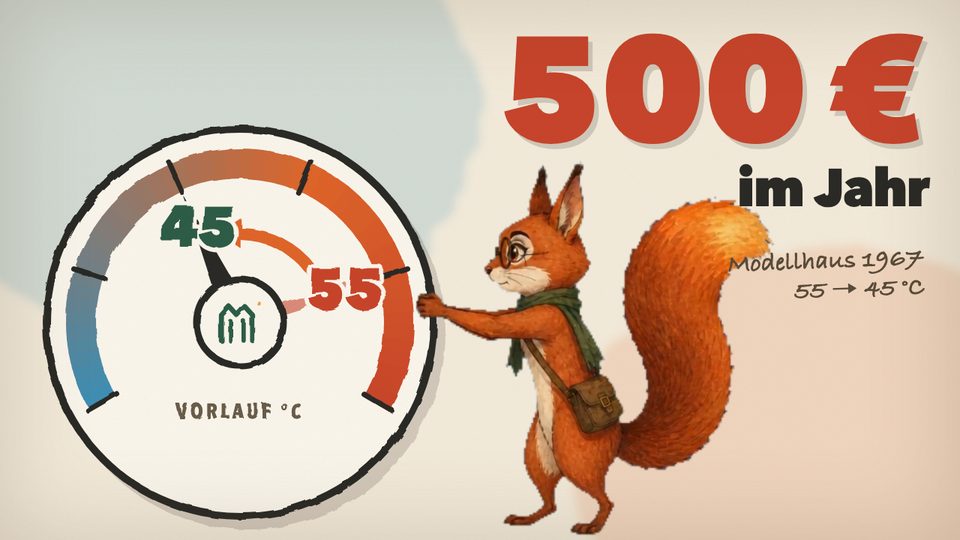
- In the model house, 45 instead of 55 °C means around a fifth less electricity, a good 500 euros a year.
Jump straight to the question
- Two identical houses, a €500 difference
- What exactly is the flow temperature?
- Where does the heat pump's heat come from?
- How much electricity does 1 degree more flow temperature cost?
- Can you simply turn the flow temperature down?
- What exactly is the heat load?
- What is the design outdoor temperature?
- Are old radiators enough for a heat pump?
- Worked example: which room gets cold first?
- How do you check your radiators?
- Thermostatic valves and hydraulic balancing
- How low can your house go? The test, room by room
- How do you set the heating curve?
- How efficiently is your heat pump running right now?
- What does 10 degrees less flow temperature save per year?
- What can you do if a room stays too cold?
All the numbers to check for yourself
How much heat the heat pump makes from one kilowatt-hour of electricity (COP)
Typical air-to-water heat pump, values as in the data sheet. At an outdoor temperature of 2 °C:
| Flow temperature | COP at 2 °C outdoors | Heat from 1 kWh of electricity | of which from the outdoor air |
|---|---|---|---|
| 35 °C | 4.1 | 4.1 kWh | 3.1 kWh |
| 45 °C | 3.2 | 3.2 kWh | 2.2 kWh |
| 55 °C | 2.5 | 2.5 kWh | 1.5 kWh |
At −7 °C outdoors, the same unit still delivers just under three times as much heat as the electricity it uses at a flow temperature of 35 °C, but only twice as much at 55 °C. You don't pay for the heat from the outdoor air; you pay for the electricity that carries it into the house.
Heat load of the model house
- −12 °CDesign outdoor temperature (design day)
- a good 11 kWHeat load on the design day
- about 6 kWon a winter day at 2 °C
- 21,000 kWhHeat over the whole year
In Germany, the design outdoor temperature is between about −10 and −16 °C, depending on the location. You can find the value for your postal code on the climate map of the German Heat Pump Association (Bundesverband Wärmepumpe).
Two rooms at a flow temperature of 45 °C
A radiator's rated output applies to water at about 70 °C. At a flow temperature of 45 °C, only just over a third of it is left.
| Room | Rated output | at 45 °C flow temperature | Demand on the coldest day | Result |
|---|---|---|---|---|
| Bedroom | 1,800 W | around 650 W | 500 W | enough |
| Living room | 1,500 W | around 540 W | 750 W | not enough, settles at about 18 °C |
What 10 degrees less flow temperature saves per year
| Flow temperature | Heat per year (estimated) | Electricity per year | Cost at 30 ct/kWh |
|---|---|---|---|
| 55 °C | 21,000 kWh | around 8,400 kWh | around €2,520 |
| 45 °C | 21,000 kWh | around 6,600 kWh | around €1,980 |
| Difference | around 1,800 kWh, a fifth | a good €500 a year |
Your house may need more or less heat, but the fifth stays roughly the same.
How to find your lowest flow temperature
- Open the thermostatic valves. In the main rooms, turn the thermostatic valves all the way up. Otherwise they throttle the water flow, and the flow temperature ends up set higher than necessary.
- Lower the heating curve in small steps. Change only one value at a time, the slope or the shift, and wait a few days each time. The house responds slowly. If it's too cool on cold days, the curve is too flat; if it's too warm on mild days, the whole curve is too high.
- Note the bottleneck. If a room gets too cold, you've found your bottleneck. Remember that room instead of turning the whole house back up.
- Keep a log. Write down the outdoor temperature, the flow temperature and the room temperature in the bottleneck room. Many heat pumps also show the electricity used and the heat delivered: divide the heat by the electricity and you'll see how efficiently the system is running right now.
My measurement log
| Date | outdoors (°C) | Flow temperature (°C) | Bottleneck room (°C) | Electricity (kWh) | Heat (kWh) | Note |
|---|---|---|---|---|---|---|
Short answers
What is the flow temperature?
The temperature at which the heating water leaves the heat pump on its way to the radiators. The temperature at which it comes back is called the return temperature.
How much electricity does one degree more flow temperature cost?
As a rule of thumb, around 2.5 %. Ten degrees more means around a quarter more electricity for the same heat.
Are old radiators enough for a heat pump?
Often yes, but not everywhere. At a flow temperature of 45 °C, a radiator delivers only just over a third of its rated output. Because many houses need less heat today than when they were built, and many radiators were generously sized, that is enough in most rooms. You have to check each room individually.
What is the 55-degree test?
A simple test of whether a house gets warm with a flow temperature of no more than 55 °C. In the video I do it more thoroughly: room by room and downward in small steps, until you know your bottleneck room.
What can you do if a room stays too cold?
Three options: raise the heating curve on the few cold days (for the whole house, because there is usually only one heating circuit), install a larger radiator in the bottleneck room, or accept the few expensive days. The next video shows which option pays off.
Where the numbers come from
- COP values: typical air-to-water heat pump, data sheet values A2/W35, A2/W45, A2/W55 and A−7.
- Heat load: simplified method based on DIN EN 12831, U-values by building age class (TABULA and the German official notice BAnz AT 04.12.2020).
- Radiator output: rated output according to EN 442 at 75/65/20 °C, converted to the flow temperature.
- Design outdoor temperature by postal code: climate map of the German Heat Pump Association (Bundesverband Wärmepumpe) (DIN/TS 12831-1).
- Background on heat pumps in older houses: co2online; on the 55-degree test: Utopia.
The model house in the video is my own house, built in 1967; the values are my own experience and estimates, not professional planning. For subsidies and system sizing, you need a room-by-room heat load calculation by professionals. The voice and some images in the video are AI-assisted; the script, calculations and graphics are by Millistead.
Transcript (translated from German)
Show the full transcript
0:00 · Two identical houses, a €500 difference
Two identical houses built in 1967, both with a heat pump, both at 21 degrees. But one of them pays a good 500 euros more for electricity every year. The reason is down in the basement: a single value, the flow temperature. But careful: if you simply turn it down, you may end up sitting in a cold living room in January. Today we'll clear up two things: what every degree costs you, and how low your house can really go. To do that, we'll first look at what this one value actually does in the house. On Millistead I'm making my 1967 house efficient step by step, and I show the honest math for every step. The first step: the flow temperature.
0:49 · What exactly is the flow temperature?
What exactly is the flow temperature? Let's start inside the house. The heat pump heats water. It flows through pipes to every radiator, gives off its heat to the room there and comes back cooled down. The temperature at which the water sets off is called the flow temperature. The temperature at which it comes back is called the return temperature. If the flow temperature is high, the radiator gets really hot. If it's low, it only gets warm. Whether that's enough depends on two things. How big the radiator is and how much heat the room is losing at that moment. A large radiator can do the job even when it's lukewarm. A small one can't. Then it gets cold in exactly that room. And that's the mistake many people make. They turn the flow temperature down for the whole house without first knowing which room will give up first.
1:39 · Where does the heat pump's heat come from?
But where does the heat come from in the first place? A heat pump doesn't make heat. It carries it, like a sponge. Outside, its refrigerant is even colder than the winter air. So it soaks up heat, even in frost. Inside the unit, the sponge is squeezed. That makes it hot, and the heat passes into the heating water. Then it relaxes, turns ice-cold again and fetches the next load. Your fridge works exactly the same way, by the way, just in the other direction. It carries the heat out of the cold compartment into the kitchen. But the hotter the water needs to be in the end, the harder it has to be squeezed. And that is exactly what costs electricity. How much? A staircase will show us.
2:22 · How much electricity does 1 degree more flow temperature cost?
How much electricity does 1 degree more flow temperature cost? Imagine the heat pump has to carry the heat up a staircase. At the bottom is the outdoor air, about 2 degrees on a typical winter day. At the top is the flow temperature. Every step is 5 degrees, and every step takes effort. How well a heat pump works comes down to a single number. How much heat does it make from one kilowatt-hour of electricity? Experts call this the COP. At a flow temperature of 35 degrees, a typical air-source heat pump gets around 4.1 kilowatt-hours of heat out of one kilowatt-hour of electricity. 3 of those come from the outdoor air. You don't pay for those. You only pay for the electricity that carries them into the house. At 45 degrees it's still 3.2. At 55 degrees only 2.5. Values like these are in every manufacturer's data sheet. You just have to know which table to look in. So 10 degrees more flow temperature means around a quarter more electricity. For exactly the same heat in the house. As a rule of thumb, 2.5 % for every degree. And when it gets really cold outside, the staircase gets longer. At minus 7 degrees, the unit still delivers just under three times as much heat as the electricity it uses with a flow temperature of 35 degrees. With 55 degrees, only twice as much. So the coldest days are the most expensive. And those are exactly the days when the house needs the most heat.
3:47 · Can you simply turn the flow temperature down?
So just turn the flow temperature down and that's it? This is exactly where the mistake happens. Because whether a low flow temperature is enough isn't decided by the heat pump. Your house decides that. Let's take a look. My house was built in 1967. Basement, masonry walls, gable roof, around 125 square meters of living space. Heating oil was cheap back then. There was hardly any insulation. A lot has happened since. In the 90s it got new windows. Later the roof was insulated. The facade is still uninsulated today. That's what it looks like in many German houses. Whether a house like this can get by with a low flow temperature depends above all on how much heat it loses. There's a technical term for that: the heat load.
4:36 · What exactly is the heat load?
What exactly is the heat load? Picture it as a bucket with holes. The heat in the house is the water. The walls, the windows and the roof are the holes. The colder it is outside, the faster it runs out. For it to stay at 21° inside, exactly as much heat has to flow in as is lost. That amount is called the heat load. It is measured in kilowatts. Every renovation plugs holes. The new windows, the insulated roof. The bucket loses considerably less today than in 1967.
5:09 · What is the design outdoor temperature?
A heating system has to be powerful enough to keep the house warm even on the coldest day of the year. But how cold a day do you plan for? For every location in Germany there is a fixed calculation value for that. The so-called design outdoor temperature. Depending on the region, it is between about minus 10° and minus 16°. A heating system is sized for that day. For my house it's minus 12 degrees. The heat losses at that temperature give its heat load: a good 11 kilowatts. The important part? There are only a few days like that in a year. On a normal winter day at 2°, the same house needs only about 6 kilowatts. So just over half. Over the whole year, that adds up to an estimated 21,000 kilowatt-hours of heat, give or take. By the way, the size of the heat pump should be based on exactly this heat load. If it's too big or too small, it gives away efficiency. There's a separate video on that. And that brings us to the radiators.
6:08 · Are old radiators enough for a heat pump?
Are old radiators enough for a heat pump? A radiator gives off heat because it is warmer than the air in the room. The bigger this temperature difference, the more heat flows. How much heat a radiator can give off is called its output, measured in watts. The manufacturer states it in the catalog, for every type and size. But this rated output applies to water at about 70 degrees, so a good 50 degrees warmer than the room. At a flow temperature of 45 degrees, the radiator is on average only a good 20 degrees warmer than the air. And because the output drops faster than the temperature difference, only just over a third is left. That sounds like far too little. But think of the bucket. The house needs less today. And many radiators were generously sized from the start.
7:00 · Worked example: which room gets cold first?
Let's run the numbers for two rooms in my house. In the bedroom there's a large radiator with a rated output of 1,800 watts. At 45 degrees it still delivers around 650 watts. On the coldest day, the room needs 500. That works! In the living room there's a smaller radiator with 1,500 watts. At 45 degrees, around 540 watts are left. But on the coldest day the room needs 750. Here it isn't enough. On the cold days, the living room settles at about 18 degrees. That's exactly why every room has to be checked individually. It's not the house as a whole that decides, it's the weakest room.
7:41 · How do you check your radiators?
How do you check this in your own home? Measure your radiators. Height, length and how many panels sit one behind the other. With that, you can find the rated output in the manufacturers' tables. How much heat each room needs is something an energy consultant or heating installer can work out. Or you use my free Room calculator. You'll find the link in the description. And at the end you get all the values as a document. Then you compare room by room. The output at the flow temperature you want against the demand on the coldest day. Where it gets tight, you know which room will get cold first. That's exactly where it's worth taking a closer look, not in the whole house.
8:20 · Thermostatic valves and hydraulic balancing
Two things help before you start thinking about new radiators. First, open the thermostatic valves in the main rooms all the way. Otherwise they throttle the water flow, the rooms warm up more slowly, and the flow temperature ends up set higher than necessary. Second, hydraulic balancing. Water always takes the easiest path, like in a garden hose with several branches. Without balancing, the nearby radiator gets too much and the distant one too little. A professional installer sets how much water is allowed to flow through each radiator. For subsidized heat pumps, this is even mandatory. And with a simple test you can find out how low your house can really go.
9:00 · How low can your house go? The test, room by room
How low can your house go? Many people know the test for this as the 55-degree test. We'll do it more thoroughly: room by room. This is how you find your lowest flow temperature. 1. Turn the thermostatic valves in the main rooms all the way up. 2. Lower the heating curve in small steps and wait a few days each time. The house responds slowly.
9:24 · How do you set the heating curve?
A quick word on the heating curve itself. It defines which flow temperature runs at which outdoor temperature. The colder it is outside, the warmer the water. On most controllers you set two things for this. The slope, meaning how strongly the flow temperature rises as it gets colder, and a shift, which moves the whole curve up or down. If it's too cool on cold days, the curve is too flat. If it's too warm on mild days, the whole curve is too high. Change only one value at a time, and only by a small step. 3. If a room gets too cold, you've found your bottleneck. Remember that room instead of turning the whole house back up. 4. Write down how cold it was outside, which flow temperature was running and how warm it got inside. After a few weeks you'll know your house better than any table does.
10:13 · How efficiently is your heat pump running right now?
One more tip. Many heat pumps show how much electricity they have used and how much heat they have delivered. Divide one by the other and you'll see how efficiently your system is running right now. The display is often only an estimate, but it's good enough for comparing. Note the value every month and you'll see in black and white what each change
10:32 · What does 10 degrees less flow temperature save per year?
has achieved. And what does that get you? My house needs around 21,000 kilowatt-hours of heat a year, by my estimate. That hasn't been measured yet. With a flow temperature of 55 degrees, that takes around 8,400 kilowatt-hours of electricity. With 45 degrees, around 6,600. That's a fifth less. At 30 cents per kilowatt-hour, that's a good 500 euros. Every year. Your house may need more or less heat, but the fifth stays.
11:04 · What can you do if a room stays too cold?
What can you do if a room stays too cold? In my house that's the living room. On the few days at minus 12 degrees, 45 degrees isn't enough there. And one more thing. In cold like that, my heat pump doesn't manage the full 11 kilowatts. Then an electric backup heater kicks in. It turns one kilowatt-hour of electricity into exactly one kilowatt-hour of heat, not three or four. So what to do? You could raise the heating curve on those days, for the whole house, because there is usually only one heating circuit. You could install a larger radiator in the living room. Or you simply accept the few expensive days. Which option pays off for me, and whether new radiators are really necessary, is what we'll look at in the next video. With all the numbers. Until then, you can use the free Room calculator on the Millistead website to work out how low your own house can go. You'll find the link in the description. See you then!